

Ford Air Conditioning Recharge at Our Walsall Garage
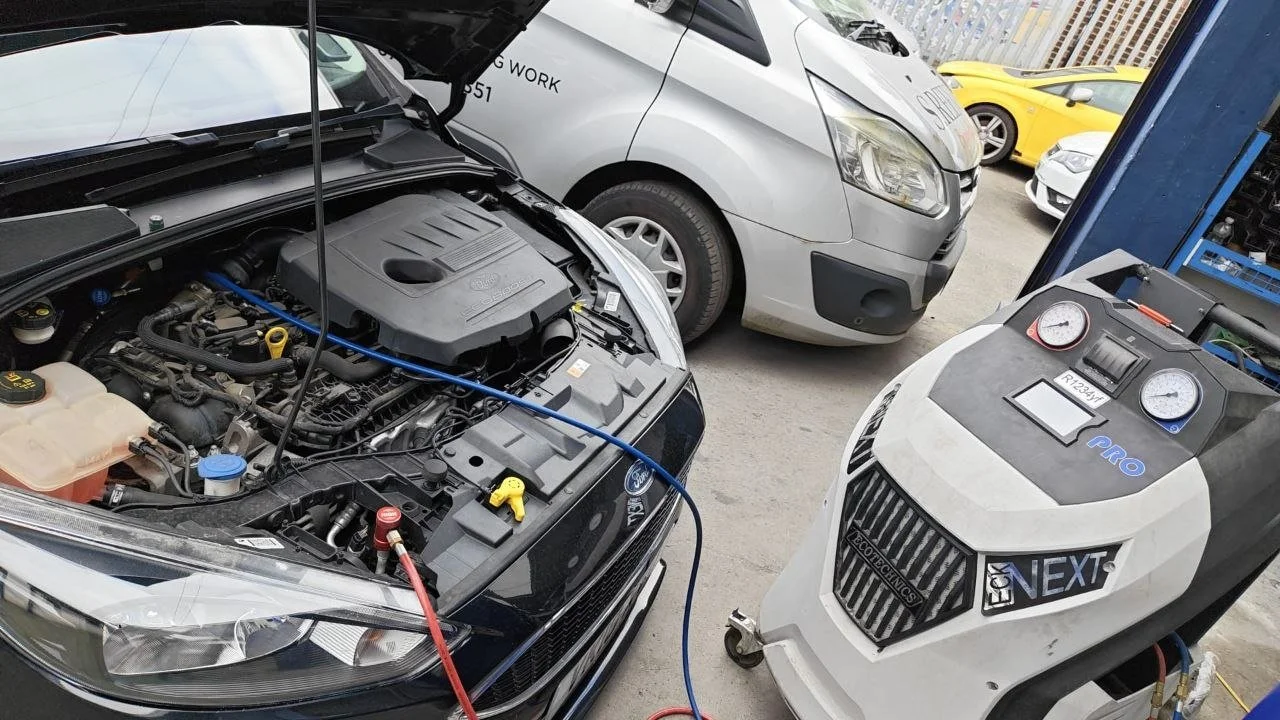
A Ford came into us at our Walsall workshop with a familiar complaint, the air conditioning was running but not blowing cold. On a warm day that quickly becomes uncomfortable, and it is easy to put up with it and keep driving. The problem is that a system that is low on refrigerant does not just mean warm air. Left long enough, it starts causing damage to components that are expensive to replace.
Air conditioning works by circulating a refrigerant gas around a closed loop. That gas absorbs heat from inside the cabin and releases it outside, which is what produces the cold air. Over time, small amounts of refrigerant can escape through microscopic seals and joints. This is normal wear and it does not mean anything is broken, but the system gradually loses its ability to cool down as the level drops. On this Ford the gas level had dropped enough that the system was no longer able to bring the cabin temperature down to where it should be.
A Low System Puts Extra Strain on the Compressor and Can Lead to a Bigger Bill
The compressor is the pump at the heart of the air conditioning system. It keeps the refrigerant moving around the loop. When the refrigerant level is too low, the compressor has to work harder to try to compensate, and it runs under more stress than it was designed for. Keep driving like that for long enough and the compressor can wear out prematurely. A compressor replacement costs significantly more than a recharge, so dealing with a low system early is always the cheaper option. On top of that, we check the system for leaks as part of the process, so if there is a larger underlying problem we will find it before it develops further.
We Removed the Old Refrigerant, Tested for Leaks and Refilled to the Correct Pressure
To carry out the recharge we connected the vehicle to our air conditioning service machine. The machine extracts whatever refrigerant is left in the system, measures exactly how much came out and checks the system holds a vacuum, which tells us whether there is a significant leak present. Once we were satisfied the system was sealed correctly, we refilled it with fresh refrigerant to the manufacturer's specified weight and pressure for this Ford. Getting that pressure right matters. Too little and the system still will not cool properly. Too much and you can damage seals and components. After the refill we ran the system and confirmed the air conditioning was blowing cold before the car went back to the customer.
Signs to Watch for on Your Own Car and How to Book In
If your air conditioning is blowing air that feels lukewarm rather than cold, or if it cools at first and then loses its chill after a few minutes, those are the early signs that the system is running low on refrigerant. You might also notice the system struggling more on hotter days. Most vehicles benefit from an aircon recharge every two to three years as routine maintenance, even if nothing feels wrong yet.
We carry out air conditioning recharges and full system checks here in Walsall, and it is one of those jobs that is straightforward to deal with now and much more costly to ignore. If your air con is not performing as it should, get in touch with us or book your car in at platinumvehicleservices.co.uk.
Ford Fiesta Worn Ball Joint Diagnosed and Inspected at Our Walsall Garage
A blue Ford Fiesta came into us here at Platinum Vehicle Services after the owner noticed the car had not been feeling quite right through the front end. There was no dramatic single event that prompted it, just a gradual sense that the steering was not as precise as it used to be and an occasional knock that had been getting a little more noticeable over time. We put it straight up on the lift and started working through the front suspension to find out what was going on.
The Lower Control Arm Ball Joint Had Excessive Side to Side Play and Was Clearly Past the Point of Acceptable Wear
With the vehicle raised, we went through the front suspension methodically. When we got to the lower control arm ball joint on the front, the problem was obvious. A ball joint is the pivot point that connects the lower control arm to the steering knuckle. It allows the wheel to move up and down with the road surface while also turning left and right when you steer. It needs to be tight. When we gripped the joint and applied lateral pressure, there was clear, visible side-to-side movement that should not have been there. A healthy ball joint has essentially no free play at all. What we were seeing on this Fiesta was a joint that had worn through its housing and was moving independently of where it should be sitting. That is not a grey area. It is a failed component.
Leaving a Worn Ball Joint on the Road Means the Wheel Can Move in Ways the Driver Cannot Predict or Control
It is worth being clear about what a ball joint actually does when it fails completely, because this is not just a comfort issue. The ball joint is what keeps the wheel correctly located under the car. If that joint lets go while the vehicle is moving, the wheel can collapse outward or inward depending on the forces acting on it at that moment. At low speed in a car park, that could mean loss of steering control. At higher speeds on a dual carriageway, the consequences are significantly more serious. Short of a catastrophic failure, the deterioration in handling is also progressive. The excessive play we found means the wheel is not sitting at a consistent geometry. The steering will pull, the car will feel vague, and the driver is working harder than they should be just to hold a straight line. Tyre wear also becomes uneven because the contact patch is not staying where it should be. A tyre that wears unevenly costs you money at the next replacement and can develop irregular wear patterns that reduce grip. The longer a worn ball joint is left, the more it tends to damage surrounding components as well, including the control arm bushes and the steering knuckle itself, which pushes the repair cost upward.
The Ball Joint Was Identified for Replacement and the Full Front Suspension Checked as Part of the Inspection
We documented what we found and presented it clearly to the owner so they could see exactly what we were looking at. The excessive play in the lower control arm ball joint was the primary finding, and replacement was the only appropriate course of action. As part of the inspection process, we also worked through the rest of the front suspension to make sure nothing else had been affected by the additional stress that a worn joint puts on surrounding components. Catching problems at this stage, before a joint fails entirely, is the difference between a manageable repair and a much more involved job.
If your car has been pulling to one side, producing a knock or clunk through the front end, or just not feeling as settled through corners as it used to, those are the signs that something in the suspension or steering is worth looking at. It does not always mean the ball joint specifically, but the front suspension is the right place to start. We see these faults regularly at our garage in Walsall, and in most cases, the sooner the vehicle comes in, the simpler and less expensive the repair turns out to be. If any of that sounds familiar, get in touch with us or book online at platinumvehicleservices.co.uk and we will take a proper look.
Ford Fiesta AC Regas in Walsall: Getting the Air Conditioning Cold Again Before Summer
A silver Ford Fiesta came into us here at Platinum Vehicle Services needing its air conditioning seen to. The owner had noticed the air coming through the vents was no longer as cold as it should be, which is a common complaint as we head into the warmer months. Before we did anything else, we connected our manifold gauge set to the system's service ports to see exactly what the refrigerant pressure was reading and work out what the system needed.
The AC System Was Low on Refrigerant and Not Producing Enough Cooling to Be Useful
When we hooked up the red and blue manifold gauge hoses to the high and low pressure service ports, the readings came back below where they should be. On a system like this, you want to see the low side sitting somewhere in the region of 25 to 35 PSI when the engine is running and the AC is active. What we were seeing told us the refrigerant level had dropped enough that the system was struggling to do its job properly. This is not unusual. R134a refrigerant, which is what this generation of Fiesta uses, can permeate slowly through seals and hoses over time even without a specific leak. A car that has not had its AC regassed in several years will often end up in exactly this situation. The compressor was cycling and the system was technically running, but without adequate refrigerant charge, the heat exchange process breaks down and you end up with air that is barely cooler than the ambient temperature outside. In warm weather that is not just uncomfortable, it makes the car genuinely difficult to drive for long periods, particularly in traffic.
Leaving the System Undercharged Puts Extra Strain on the Compressor and Can Lead to a Much Bigger Bill
It is worth understanding what happens when an AC system is run in a low refrigerant state for an extended period. The refrigerant in these systems does not just carry heat away from the cabin, it also carries the compressor oil that lubricates the compressor internals. When the refrigerant level is low, that oil circulation is reduced. Over time, running the compressor without adequate lubrication causes accelerated wear on the internal components. An AC compressor on a car like this can cost anywhere from 200 to over 400 pounds to replace, depending on the part and the labour involved in accessing it. A regas service costs a fraction of that. If you are noticing that your AC is blowing warm and you keep putting off booking it in, you are taking a risk with a component that is significantly more expensive to replace than it is to maintain properly.
The System Was Recharged to the Correct Pressure and the Air Was Tested Cold Before the Car Left
We recovered any remaining refrigerant from the system, drew it down into a vacuum to remove moisture and check for any significant leaks holding in the lines, and then recharged it with the correct amount of R134a refrigerant to bring the system back to the manufacturer's specified pressure range. Once recharged, we ran the system with the engine at idle and checked the vent temperature using a probe thermometer. The air coming through the vents was dropping down to the kind of temperatures you expect from a properly functioning system, well below 10 degrees Celsius at the vent with the blower on a mid setting. The car left with a fully functioning AC system ready to handle the summer heat.
If your car's air conditioning is blowing warm, or if it takes a long time to cool the cabin down even when you turn it up to full, that is usually the first sign that the refrigerant level needs attention. Other things to look out for are a musty smell when the AC is running, which can indicate moisture in the system, or the compressor clutch clicking on and off rapidly rather than engaging steadily. We carry out AC regas services here in Walsall as part of our wider vehicle maintenance offering, and we have the equipment to handle the full process properly, not just top up and hope for the best. If you want your air conditioning working as it should ahead of summer, get in touch with us at platinumvehicleservices.co.uk to book your car in.
