

Vauxhall Vivaro Brake Pad, Disc and Caliper Replacement in Walsall
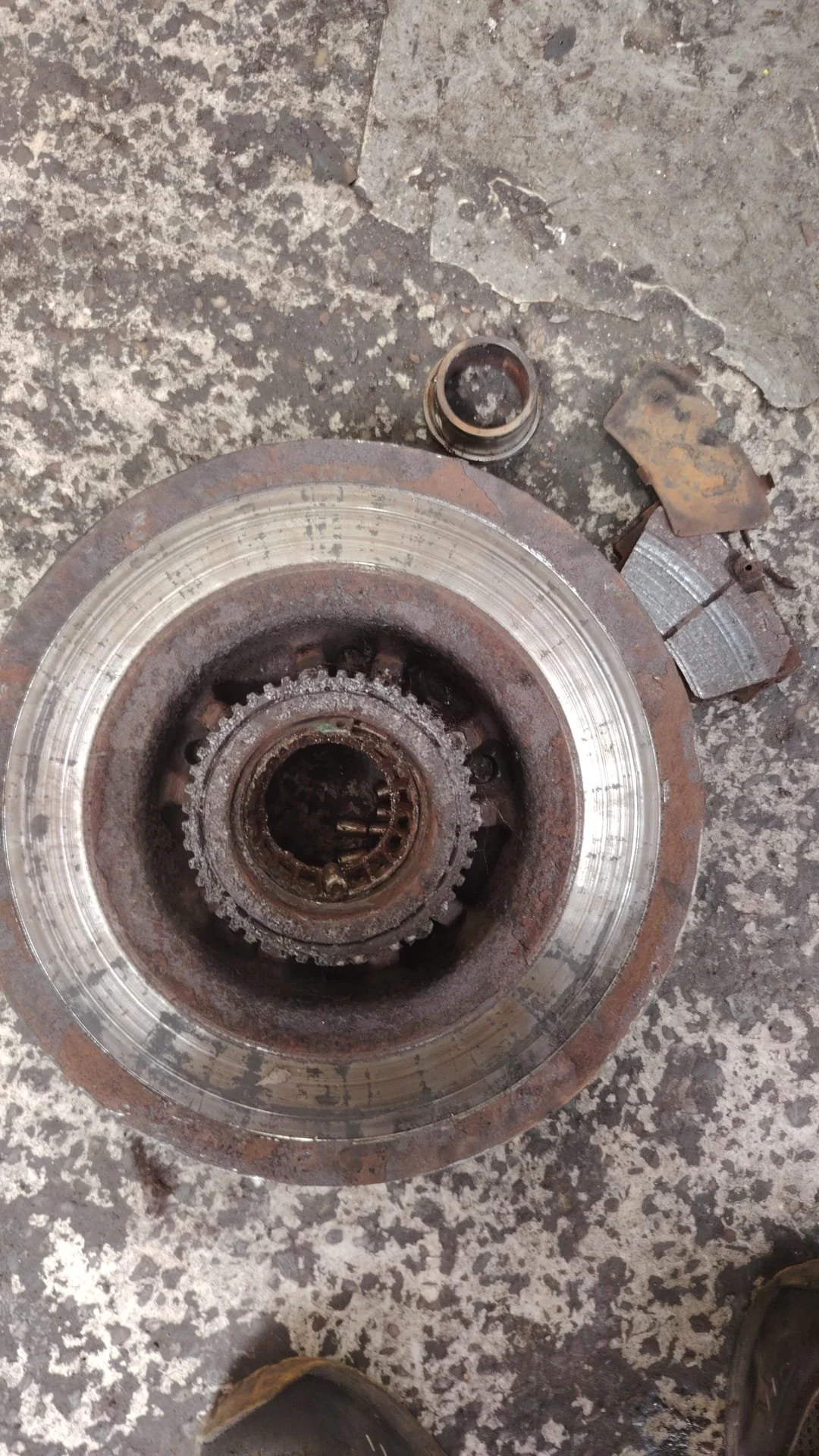
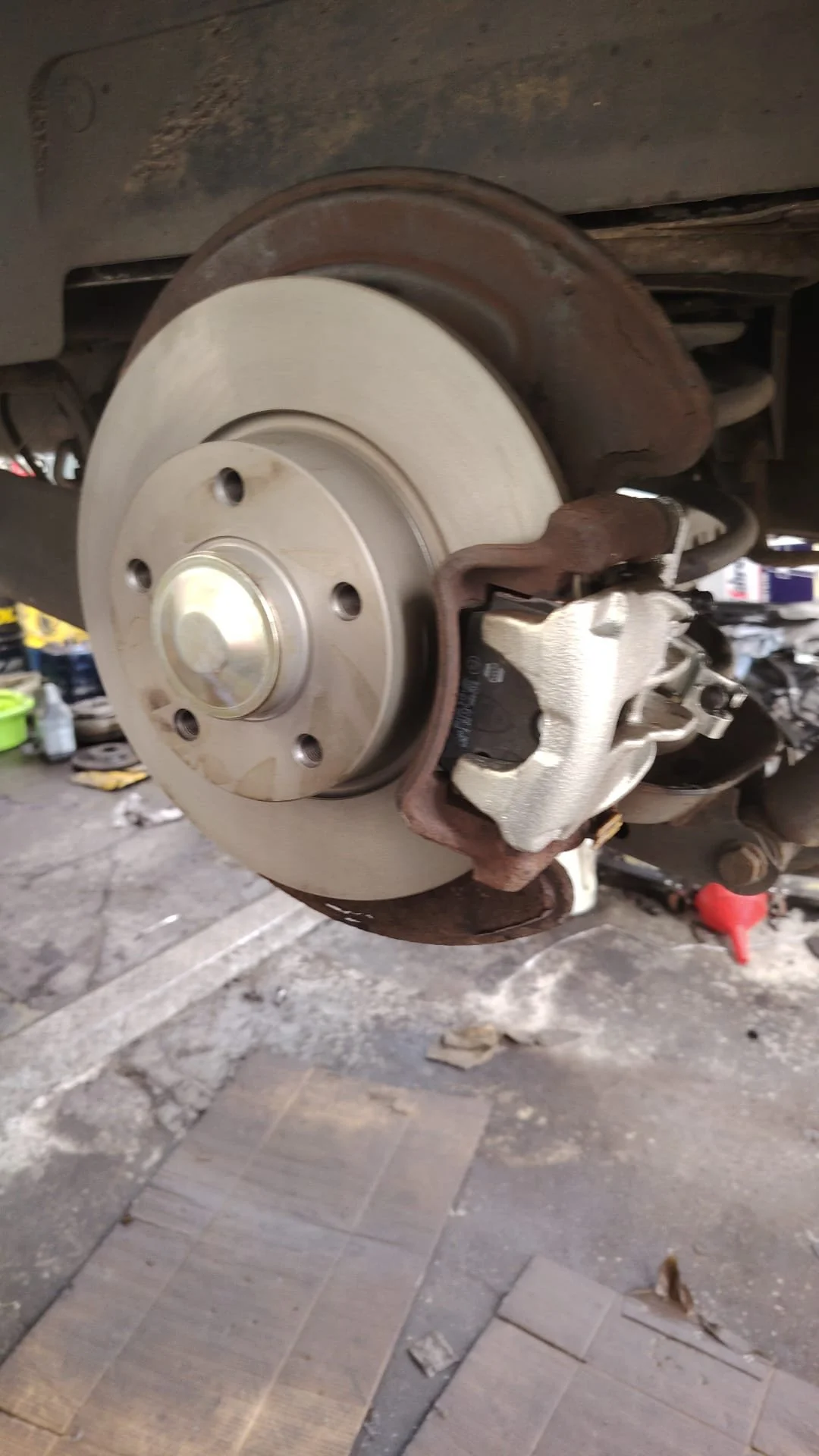
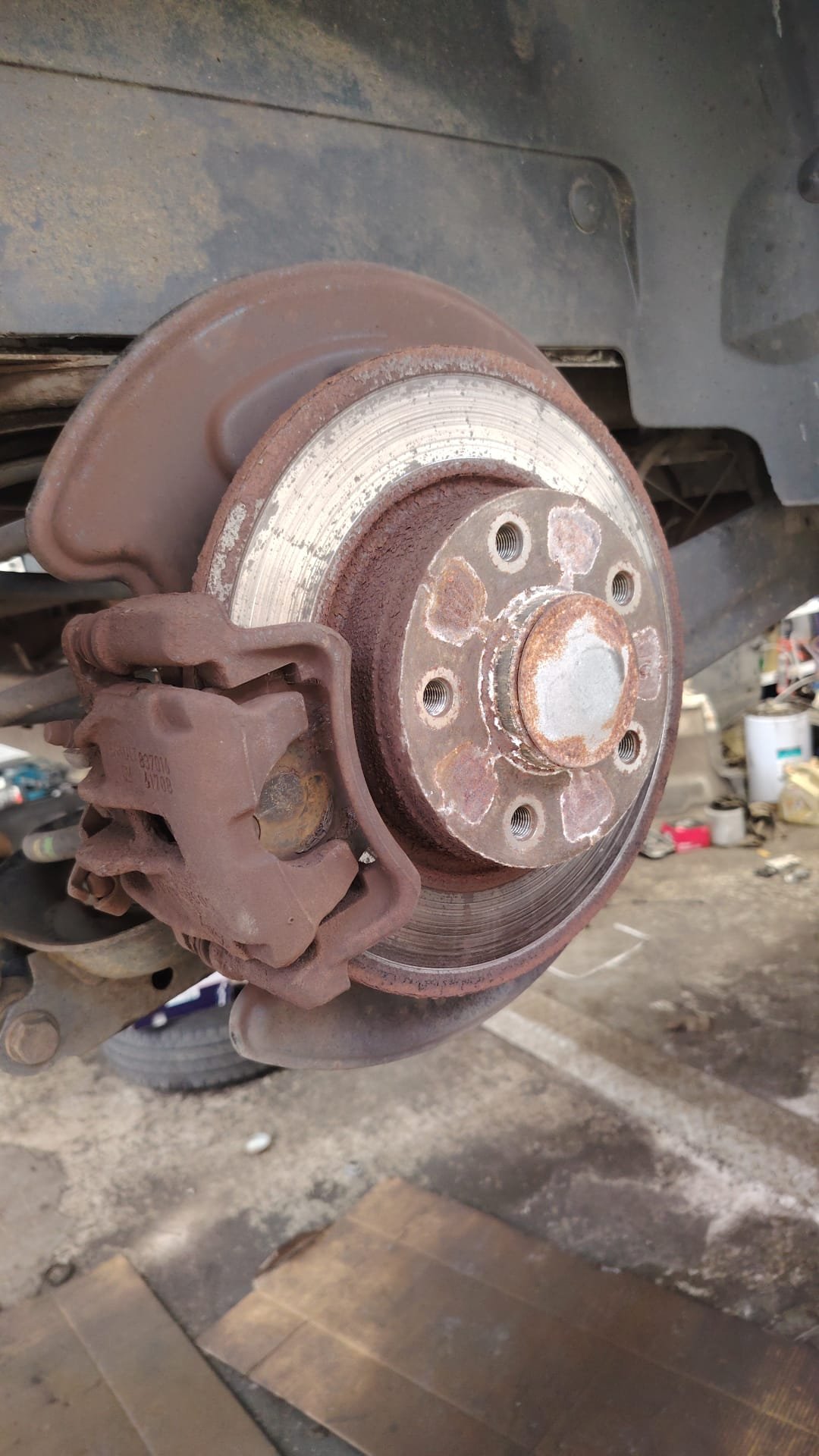
We had a Vauxhall Vivaro in with us recently, brought in because the driver had noticed the brakes were feeling less responsive and there was a low grinding noise when stopping. For a van that size, carrying loads day in and day out, the braking system works hard and the components wear faster than most owners expect. When we got it up on the ramp and took the wheel off, it was clear this one needed more than a straightforward pad swap.
The Pads Were Worn Down and the Disc Had Reached the Limit of Safe Use
With the wheel removed we could inspect the brake pad thickness directly. The pads had worn down to around 2mm. The minimum we would consider safe for a vehicle of this weight is 3mm, and the legal limit sits at 1.6mm. At 2mm there is very little material left before the metal backing plate makes contact with the disc. Once that happens, the disc surface gets scored and grooved, and what started as a pad replacement becomes a disc replacement as well. In this case the disc had already reached its minimum thickness limit, measured with a micrometer at the thinnest point. A brake disc that has worn to its minimum can flex slightly under heavy braking, which reduces your stopping power at exactly the moment you need it most.
The caliper, which is the clamp that squeezes the pads against the disc to stop the vehicle, was also seized. A seized caliper means one side of the pad is pressing harder than the other, or pressing constantly even when you are not braking. That uneven pressure is what accelerates wear on both the pads and the disc unevenly, and it also generates heat that can lead to brake fade, where the brakes become progressively less effective the harder you use them.
Leaving These Faults Would Have Cost More and Created a Real Safety Risk on the Road
A van like the Vivaro can weigh over 2,000 kilograms when loaded. At 60 miles per hour, the difference between brakes that are working correctly and brakes that are not can mean several extra metres of stopping distance. That is not a small margin. On a motorway or dual carriageway, those metres matter considerably. Beyond the safety side, leaving worn pads and a scored disc means the disc surface deteriorates further with every journey. A disc that could have been replaced on its own becomes a disc and caliper job regardless, and you are paying for both whether you act now or in three months time. Acting when the fault is first found is always cheaper.
This Model Has a Disc With a Built In Wheel Bearing, So the Whole Assembly Comes Off as One Unit
One thing worth explaining about this particular Vivaro is that the brake disc on this axle has an integrated wheel bearing. The bearing is the component that allows the wheel to spin smoothly on the axle. On most cars the disc and the bearing are separate parts, but on this model they are combined into a single assembly. That means when the disc needs replacing, you cannot remove just the disc. The entire unit, disc and bearing together, has to come off as one piece. We used a hub puller to draw the assembly free from the axle without causing damage to the surrounding components. The new disc and bearing assembly was then pressed and torqued into place to the manufacturer specification. Once everything was fitted we bled the brake system to remove any air from the hydraulic lines, because air in the lines causes a soft or spongy pedal feel and reduces braking response. A full road test confirmed the pedal feel was firm and the braking performance was correct before the van went back to the owner.
What to Watch For on Your Own Vehicle and How to Book in With Us in Walsall
Brake jobs like this one are a regular part of what we do here at Platinum Vehicle Services in Walsall. We work on vans as well as cars, and we carry out everything from a single pad replacement through to full brake overhauls involving discs, calipers and brake fluid changes. If you notice any of the following, get your vehicle checked sooner rather than later, a grinding or squealing noise when braking, a pulsing or vibrating feeling through the brake pedal, the van or car pulling to one side when you brake, or a pedal that feels softer or lower than it normally does. Any one of those signs can mean the brakes are at or near the point where they need attention.
We are based in Walsall and serve drivers and van operators across the West Midlands. You can find out more and book your vehicle in at platinumvehicleservices.co.uk. If you would prefer to leave a message, you can reach us on 07970901354 at any time, 24 hours a day, seven days a week, and someone from the team will get back to you as soon as possible.
Vauxhall Corsa Air Conditioning Repair in Walsall
A Vauxhall Corsa came into us recently with the air conditioning not working at all. The driver had noticed the system was blowing warm air no matter what setting they used, which on a warm day is more than just an inconvenience. We put it on the hoist to get a proper look at what was going on underneath.
A Leaking Pipe Was Letting All the Refrigerant Escape
Once we had the car up, our mechanic traced the AC system and found a leaking pipe. The AC system works by circulating a refrigerant gas under pressure around a closed loop. That gas is what allows the system to cool the air before it reaches the cabin. When a pipe develops a leak, the refrigerant escapes into the atmosphere and the system is left with nothing to work with. That is why the air coming through the vents felt no different to opening a window.
The pipe itself had failed at a joint, which is one of the more common points of failure in an AC system. It is not always visible to the naked eye straight away, which is why a pressure check and a physical inspection of the pipework together are the right way to diagnose it properly rather than simply topping up the gas and hoping for the best.
Leaving a Refrigerant Leak Means the System Cannot Function and the Compressor Can Be Damaged
If a refrigerant leak is left and the system is just regassed without fixing the root cause, the gas will escape again within days or weeks. Beyond the wasted cost of a regas, running an AC system that is low on refrigerant puts strain on the compressor, which is the pump that drives the whole system. Compressors are significantly more expensive to replace than a pipe. Sorting the pipe first is the right order of work.
There is also a practical safety point. In warmer weather, a working air conditioning system helps keep the driver alert and comfortable on longer journeys. It also plays a role in demisting the windscreen in colder, damp conditions. A system that does not function at all leaves you without either of those benefits.
We Replaced the Faulty Pipe and Regassed the System to Get the AC Working Again
We replaced the leaking pipe with a new one and then regassed the system to the correct refrigerant level. Once the system was sealed and charged, we tested it to confirm the air coming through the vents was cooling as it should. The Corsa left us with a fully working AC system.
Air conditioning work is something we carry out regularly here in Walsall, and it covers more than just a regas. If your car's AC is blowing warm air, making an unusual noise when it kicks in, or the air has a musty smell, those are all signs worth getting checked out before a minor issue turns into a bigger bill. Book your car in with us at platinumvehicleservices.co.uk and we will take a look.
2013 Vauxhall Corsa Misfire Diagnosis in Walsall: Why We Stopped Before Replacing the Spark Plugs
This 2013 Vauxhall Corsa came into us at Platinum Vehicle Services with a misfire. The customer had been told, or at least suspected, that spark plugs were the likely cause. That is a fair assumption in most cases. A misfire on a Corsa of this age can absolutely come down to worn plugs, and a set of new ones usually sorts it. But before we start replacing parts, we always take the time to look at what is actually in front of us. In this case, what we found changed the direction of the job entirely.
Water Was Pooling Around One of the Spark Plugs and the Coolant Reservoir Was Full of Oil
When we pulled the spark plug cover and got eyes on the plugs, one cylinder had water sitting around it. That is not normal. Water in that area suggests it is getting in from somewhere it should not be, and on a petrol engine like this, the most common route is through a failed head gasket. We did not stop there. We went to check the coolant reservoir, and the customer mentioned something that immediately made us take this more seriously: they said the coolant had been clean just a week before.
When we removed the yellow reservoir cap, the inside of it was coated in a thick, dark, oil-contaminated sludge. The fluid in the reservoir was visibly contaminated too. Oil and coolant are two systems that are kept entirely separate inside the engine. They have their own channels, their own seals, and their own jobs to do. When you see oil in the coolant, it means those two systems are no longer separated. The head gasket sits between the engine block and the cylinder head, and it is what keeps oil, coolant, and combustion gases in their correct channels. When that gasket fails, the seals break down and the fluids mix. That is what we were looking at here.
Fitting New Spark Plugs at This Point Would Have Cost the Customer Money Without Fixing Anything
If we had gone ahead and fitted a new set of spark plugs without investigating further, the misfire would not have gone away. The water getting into that cylinder is what is causing the engine to run rough. New plugs would have been fouled again quickly, or the misfire would have continued regardless. The customer would have paid for parts and labour that did not address the actual problem, and then come back to us a short time later in a worse situation.
A blown head gasket left unaddressed does not stay at the same level. Once oil and coolant are mixing, the coolant loses its ability to keep the engine at the right temperature. The oil also becomes contaminated and loses its viscosity, which means it does not lubricate the engine components properly. Over time, this leads to overheating, and overheating on a petrol engine can warp the cylinder head. A warped head means the head gasket repair also requires the head to be skimmed or replaced, which adds significant cost on top of the gasket work itself. If the engine is run long enough in this condition, you can reach a point where the engine block itself is damaged, and at that stage the repair bill can exceed the value of the car.
We advised the customer on all of this before any further work was carried out. The decision on how to proceed was theirs to make with a full picture of what was going on.
The Plugs Were Left in Place and the Customer Was Given an Accurate Diagnosis to Work From
Rather than fitting plugs the car did not need at that point, we documented what we found, explained the head gasket situation clearly, and gave the customer the information they needed to decide on the next step. The correct repair here is a head gasket replacement, which involves removing the cylinder head, inspecting it for warping, replacing the gasket, and refitting everything with new head bolts and correct torque settings. The coolant system would also need to be fully flushed to remove the oil contamination before clean coolant goes back in.
This is a significant job, but it is a manageable one when it is caught at the right time. The customer came to us thinking they needed spark plugs. What they actually needed was an accurate diagnosis, and that is what we gave them.
If you drive a Vauxhall Corsa, or any petrol car of a similar age, there are a few things worth keeping an eye on. Check your coolant reservoir regularly. It should be clear or slightly tinted depending on the coolant type, never brown or sludgy. If you see a creamy or oily residue on the underside of your oil filler cap, that is another indicator that oil and coolant may be mixing. A persistent misfire that does not respond to basic maintenance, a sweet smell from the engine bay, or your temperature gauge running higher than usual are all signs worth getting looked at before they develop further.
We carry out engine diagnostics and fault investigations at our garage in Walsall, and we do not quote for work until we know what the car actually needs. If your car is misfiring, running hot, or you have noticed anything unusual with your coolant or oil, get it booked in with us before the problem has a chance to become a more expensive one. You can reach us and book an appointment at platinumvehicleservices.co.uk.
Vauxhall Corsa Air Conditioning Repair in Walsall
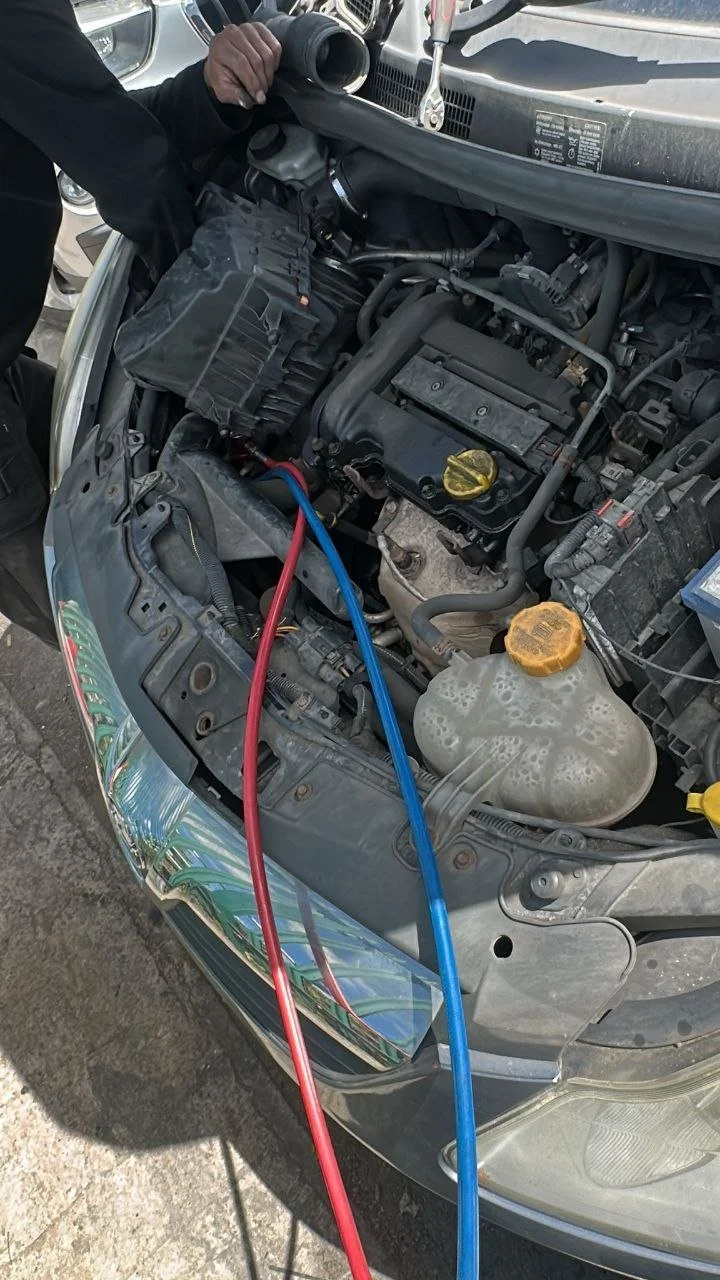
A Vauxhall Corsa came into us here at Platinum Vehicle Services with a complaint we hear fairly often this time of year. The air conditioning had stopped working. The driver had noticed it was blowing warm air regardless of the temperature setting, and had been putting up with it for a couple of weeks before deciding to get it looked at. We put it straight onto the ramp and started working through the AC system to find out exactly what was going on.
The AC System Had Lost Its Refrigerant Charge and the Compressor Was Not Engaging
The first thing we check on any AC job is whether the system holds pressure. On this Corsa, when we connected our manifold gauge set, the low-side pressure was reading far lower than it should be. A correctly charged system on this vehicle should sit somewhere in the region of 25 to 35 PSI on the low side at idle with the AC running. This one was reading close to zero, which told us the refrigerant had leaked out almost entirely. With no refrigerant in the system, the pressure switch that protects the compressor from running dry had cut it out completely. That is why the compressor clutch was not engaging and why the car was only blowing warm air. We also carried out a UV dye check to trace where the refrigerant had escaped from, and found the source at one of the service port connections where the Schrader valve was no longer sealing properly.
Leaving an Empty AC System Running Can Damage the Compressor Beyond Repair
Some customers wonder whether an AC system that is just blowing warm air is really worth worrying about, particularly outside of summer. The honest answer is that leaving it can cost you significantly more money down the line. The compressor on a Vauxhall Corsa is lubricated by oil that circulates with the refrigerant. When the refrigerant is gone, that oil is not moving around the system. If the compressor were to run in that condition, whether because the low-pressure switch failed or someone tried to force the system on, you would be looking at internal compressor damage. A replacement compressor on a Corsa can cost anywhere from 200 to 400 pounds in parts alone before labour. Fixing a faulty Schrader valve and recharging the system is a fraction of that. There is also the matter of comfort and safety. In warm weather, a car without functioning air conditioning can become very uncomfortable very quickly, and in some situations reduced driver comfort does affect concentration on longer journeys.
We Replaced the Faulty Valve, Vacuumed the System Down, and Recharged It to the Correct Specification
Once we had identified the leak point, we replaced the Schrader valve at the service port to restore a proper seal. Before recharging, we connected a vacuum pump and pulled the system down to remove any moisture or air that had got in while the refrigerant was absent. Moisture inside an AC system is a problem because it can react with the refrigerant to form acids that corrode the internal components over time. We held the vacuum for long enough to be confident the system was clean and dry before we started the recharge. The refrigerant used on this Corsa is R134a, and we charged it to the manufacturer's specified weight for the system. Once charged, the compressor engaged immediately, the pressures settled correctly on both the high and low sides, and the air coming out of the vents dropped to the temperatures you would expect from a properly functioning system.
Air conditioning faults are something we deal with regularly at Platinum Vehicle Services in Walsall. Whether it is a slow refrigerant leak, a failed compressor, a blocked condenser, or a cabin filter so blocked that it restricts airflow through the system, the symptoms often look the same from the driver's seat. If your AC is blowing warm, taking longer than usual to cool the cabin, making an unusual noise when you turn it on, or if you can smell something musty when the blowers are running, those are all signs worth having looked at before the problem develops into something more expensive. We work on all makes and models, and we will always tell you what we have found and what your options are before carrying out any work. If your air conditioning is not performing the way it should, get in touch with us or book online at platinumvehicleservices.co.uk.
Vauxhall Corsa 1.2 Turbo 100PS: What Really Matters Beyond Top Speed
The current Corsa 1.2 Turbo might hit 121 mph on paper, but what you experience every single day is far more important. Let me share what actually matters when you're considering one of these vehicles.
Daily Performance That Actually Counts
The 0 to 60 mph accelevation time of 10.7 seconds tells you much more about how this car will feel in real world driving. That's the figure that affects your overtaking on A roads around Walsall, your merging onto the M6, and how the car responds when you need a bit of extra power.
Running Costs and Fuel Economy Reality
The official 53 mpg figure is achievable with sensible driving, and that's where the Corsa really shines. In our experience servicing these vehicles, customers who maintain steady driving habits and keep up with regular maintenance often see fuel economy close to these official figures.
What affects this most is keeping the engine in good condition. A clogged air filter or worn spark plugs can easily knock 5-10 mpg off your fuel economy. We see this regularly when Corsas come in for their annual service after being neglected for extended periods.
Maintenance Schedule That Keeps Your Corsa Running
The key maintenance intervals for the Corsa 1.2 Turbo are straightforward but critical. Oil changes every 10,000 miles or 12 months keep that turbo engine happy, and we always recommend using the correct 5W-30 fully synthetic oil specification.
The timing belt replacement at 100,000 miles or 10 years is non negotiable. We've seen what happens when owners ignore this interval, and it's not pretty. The repair bill for timing belt failure far exceeds the cost of preventive replacement.
Regular servicing also catches the smaller issues before they become expensive problems. Things like worn engine mounts, deteriorating rubber hoses, and carbon build up in the intake system are all manageable when caughtearly.
