

2017 Audi A4 Wheel Bearing and Anti Roll Bar Replacement in Walsall
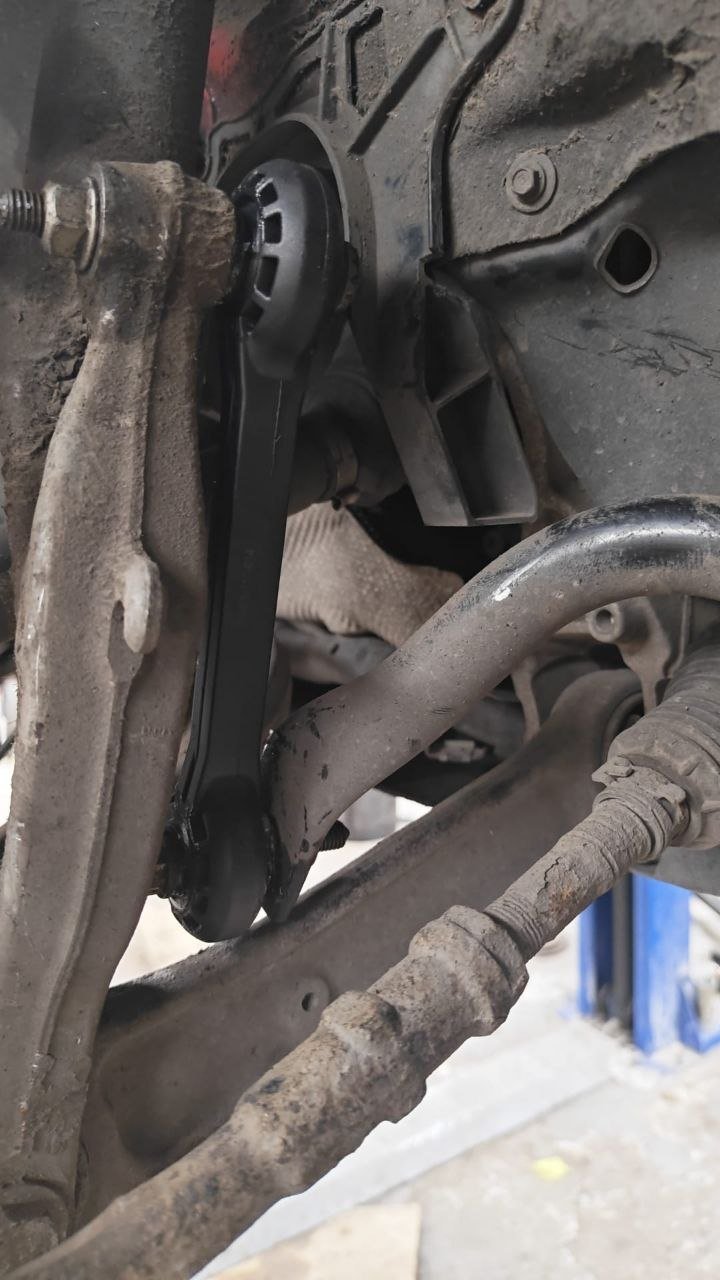
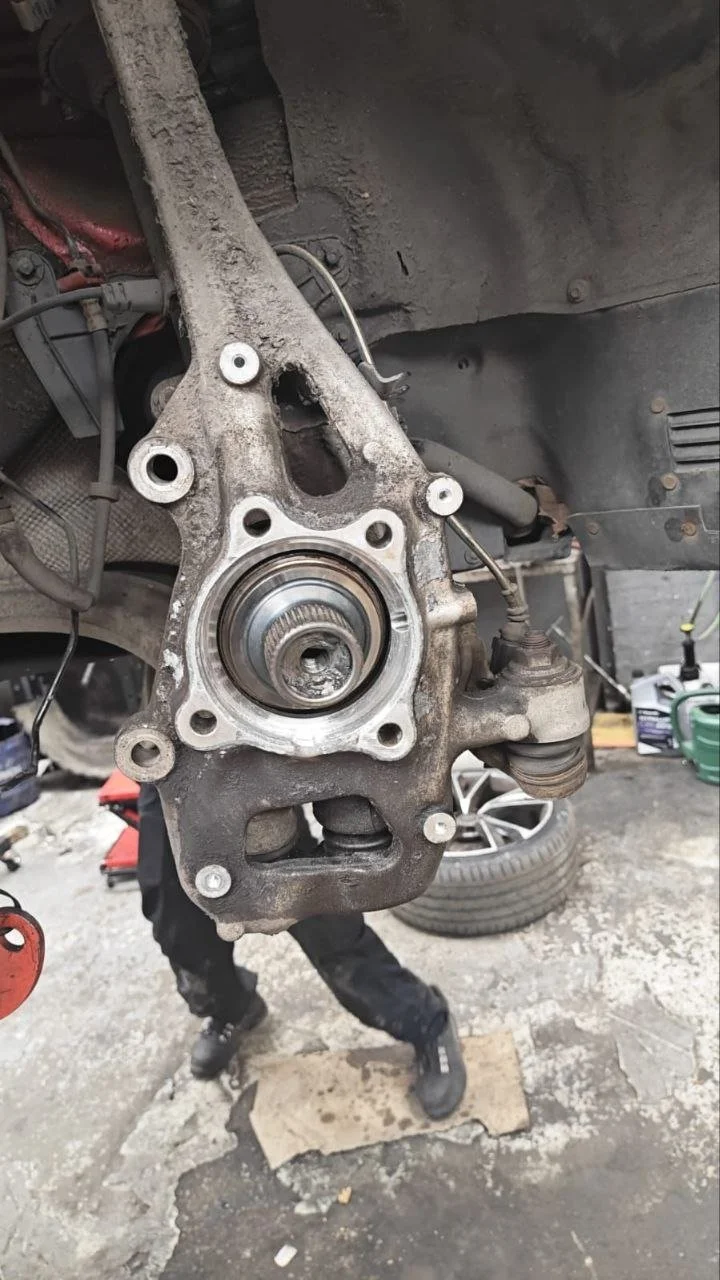
A 2017 Audi A4 came into us here at Platinum Vehicle Services with the owner reporting a low rumbling noise that had been getting gradually worse over several weeks. There was also a slight pulling sensation through the steering on faster roads. Those two symptoms together pointed us in a fairly clear direction before we had even put the car on the ramp, but we always do a proper inspection before confirming anything, and in this case what we found gave us a complete picture of what needed doing.
The Front Wheel Bearing Had Developed Significant Play and the Anti Roll Bar Drop Link Was Worn Through
Once the car was up on the ramp and the front wheel was off, we checked the hub assembly for play by gripping the wheel at the 12 o'clock and 6 o'clock positions and rocking it. There was noticeable movement, which tells you the bearing has lost its internal tolerance. A wheel bearing is designed to allow the wheel to spin freely while holding it firmly in place with no lateral or axial movement at all. When that movement starts to appear, the bearing is on its way out. On this A4, the play was enough that you could feel it clearly by hand, which means it had been deteriorating for some time. The rumbling noise the customer described is exactly what a failing bearing sounds like, caused by the rolling elements inside the bearing moving against worn or pitted raceways rather than running smoothly. While we had the front end stripped down we also inspected the anti roll bar drop links. The drop link is a short connecting rod that joins the anti roll bar to the suspension strut, and its job is to transfer load from one side of the car to the other when you go around a corner, keeping the body level and the tyres in proper contact with the road. On this car, the drop link bush was split and the joint itself had excessive free movement in it. That is what was contributing to the steering pull and the vague, slightly unsettled feel through the wheel.
Leaving Either of These Issues Any Longer Would Have Created a Real Safety Problem and a Much Larger Bill
A worn wheel bearing does not stay at the same level of wear. Once the internal play has developed to the point where it is detectable by hand, the rate at which it deteriorates tends to accelerate. The bearing generates heat as it runs in that worn state, and heat breaks down the grease inside the bearing and causes further damage to the raceways. In a worst case, a bearing that is left long enough can seize completely or shed its outer race. Either of those outcomes on a front wheel means you lose control of steering on that corner of the car. That is not a risk worth taking for the sake of getting the job done quickly. On the cost side, a bearing that is caught at this stage means you are replacing the bearing. A bearing that is left until it causes secondary damage can mean replacing the hub, the driveshaft, or in some cases components further up the suspension. The drop link is a less dramatic failure on its own, but a broken drop link means the anti roll bar is effectively disconnected on one side. The car will roll significantly more through corners, the tyre loading becomes uneven, and the handling becomes unpredictable at speed. Neither of these were something we were comfortable signing off without addressing.
New Wheel Bearing and Drop Link Fitted to the Front Axle and the Car Road Tested Before Being Returned
We pressed out the old bearing from the hub carrier using the correct press tooling, fitted a new bearing to the proper specification for a 2017 A4, and torqued everything back up to the manufacturer's settings. The drop link was replaced with a new unit, again to the correct specification, and the front end was reassembled. Once the car was back on the ground we took it out for a road test to confirm the rumble had gone and that the steering was tracking cleanly. It was. The car came back noticeably quieter and the steering felt settled and accurate again, which is exactly what it should feel like on an A4 of this age in otherwise good condition.
Suspension and bearing work is something we carry out regularly here at Platinum Vehicle Services in Walsall, across all makes and ages of vehicle. If you are driving something and you notice a low humming or rumbling noise that changes with your speed but not your engine revs, that is worth getting looked at. If the noise changes when you gently steer left or right at motorway speed, that points even more specifically to a wheel bearing. A knocking or clunking noise from the front end over bumps or when turning in a car park tends to suggest drop links, ball joints, or anti roll bar bushes. None of these things resolve themselves, and all of them affect how safely the car handles. If any of that sounds familiar, bring your car to us and we will put it on the ramp and tell you exactly what we are looking at. You can book in at platinumvehicleservices.co.uk.
Audi A1 Mini Service Uncovers Worn Brake Pads and Discs in Walsall
This Audi A1 came into us at Platinum Vehicle Services booked in for a routine mini service. Nothing dramatic on the surface. The owner had noticed no major warning signs, which is actually quite common with brake wear. You do not always feel or hear the problem until it has gone well beyond the point where it should have been caught. We removed the front wheels as part of our standard service checks, and what we found under there needed addressing before that car went back on the road.
The Front Brake Pads Had Worn Down to the Metal and the Discs Had a Visible Wear Lip Along the Outer Edge
When we pulled the front wheel off, the state of the braking system was clear. The brake pads had reached the absolute end of their usable life. There was no friction material left to speak of. At that stage the metal backing plate of the pad is making contact with the disc, which is not something you want happening at any speed. A healthy brake pad has somewhere between 10mm and 12mm of friction material when new. By the time you are at 3mm you are in the advisory zone. These pads were past that point entirely. On top of that, the brake discs themselves had developed a pronounced lip along the outer edge. That lip forms when the centre of the disc wears down through regular use but the very outer edge, which sits beyond the reach of the pad, stays at its original height. When that lip becomes visible and measurable, it tells you the disc has lost enough material across its face that it can no longer do its job properly. A disc that is worn like this has less thermal mass, meaning it absorbs and disperses heat less effectively during braking. It also has an uneven surface that prevents the pad from biting evenly and cleanly.
Leaving the Brakes in This Condition Would Have Increased Stopping Distances and Put Real Pressure on the Rest of the System
I want to be direct about what the risk is here rather than just saying it was urgent. When pads are worn to the metal and pressing against a worn disc, your braking efficiency drops significantly. Stopping distances increase, and they increase more sharply the harder you have to brake. At 30mph in normal conditions a well-maintained car should stop in around nine metres. Once the system is compromised like this, that figure goes up and you lose the predictability you rely on. There is also the question of cost. Once metal is running against metal on a worn disc, the disc surface scores and gouges quickly. In some cases that process takes only a few hundred miles. What might have been a pad and disc replacement becomes a more involved job if other components are dragged into the damage. Leaving it longer was not an option.
New Brake Pads and Discs Were Fitted to Both Front Corners and the Full Mini Service Was Completed
We replaced both front brake discs and both sets of front brake pads. When we do this job we always replace both sides together. Fitting new components to one side and leaving worn ones on the other creates an imbalance. When you press the brake pedal, the car pulls toward whichever side has more grip, and that is not something you want to find out about for the first time in a hurry. The new discs were bedded in correctly and the pads seated properly before the car left us. The rest of the mini service was also completed, covering the oil, filter, and all the checks that come with that job. The car left us in a condition we were confident about.
If Your Brakes Feel Soft, Pull to One Side, or You Can Hear Grinding When You Stop, Book in Before It Gets Worse
Brake wear is something a lot of drivers do not notice until it has gone too far. The signs to listen and feel for are a grinding or scraping noise when you brake, a pulling sensation where the car drifts left or right as you slow down, a spongy feeling through the brake pedal, or a longer distance than usual before the car comes to a stop. If any of those sound familiar, do not leave it. At Platinum Vehicle Services in Walsall we carry out brake inspections as part of our servicing work and we will always tell you exactly what we find, including the measurements, so you understand what you are dealing with. You can book your vehicle in with us at platinumvehicleservices.co.uk.
Audi A6 2.7 TDI Air Conditioning Recharge in Walsall
This Audi A6 2.7 TDI came into us here at Platinum Vehicle Services because the air conditioning had stopped doing its job. The owner told us it was blowing warm air no matter how low the temperature was set, which on a warm day makes driving genuinely uncomfortable and on hotter days can become a real problem, especially if you have children or elderly passengers in the car. Before we touched anything, we connected the vehicle to our diagnostic equipment to get a clear picture of what the system was holding and what it needed.
The AC System Was Low on Refrigerant and Unable to Cool the Cabin to Any Useful Temperature
When we ran the system check, it became clear straight away that the refrigerant level was significantly depleted. This Audi A6 uses R134a refrigerant, and the system requires a precise charge of 550 grams to operate correctly. What we found was well below that figure. The AC compressor on these cars will not engage properly when the refrigerant pressure is too low. It is a built-in protection measure that stops the compressor from running dry, but the result for the driver is that the system blows air that is the same temperature as the ambient air coming in, sometimes even warmer due to heat from the engine bay. It is not a fault with the compressor itself in most cases. It is simply that without the correct volume of refrigerant circulating through the system, there is nothing for the process to work with. Low refrigerant is the most common reason we see air conditioning systems stop cooling on vehicles of this age, and it is something that can creep up gradually over time as small amounts escape through normal wear on seals and connections.
Leaving a Low Refrigerant Level Unaddressed Risks Damaging the Compressor and Increasing the Cost of the Repair Significantly
The reason this matters beyond comfort is that if the system continues to be used while low on refrigerant, the compressor is at risk. The refrigerant itself carries the lubricating oil that keeps the compressor internals working properly. When the refrigerant level drops, so does the oil circulation. Run the compressor for long enough in that condition and you will start to cause wear that cannot be undone without replacing the compressor entirely. On an Audi A6 of this specification, a compressor replacement is a considerably more expensive job than a straightforward recharge. We see this happen more often than we should. Someone notices the air conditioning is not cold, they leave it because it is not urgent, and by the time they bring it in the damage has been done. A recharge is a contained, predictable cost. A compressor replacement is not.
550 Grams of R134a Refrigerant Charged Into the System Using Specialist Equipment and the AC Restored to Full Cooling Performance
We connected our refrigerant charging station to the Audi's service ports using the red and blue service hoses, which correspond to the high and low pressure sides of the system. The machine allows us to input the exact charge weight, so we set it to 550 grams of R134a as specified for this vehicle. The machine delivers the refrigerant in a controlled way and stops automatically once the target weight has been reached, which means there is no guesswork and no risk of overcharging. Overcharging an AC system causes its own problems, including increased pressure that can also damage the compressor, so precision here matters as much as getting the level up. Once the charge was complete, we checked that the compressor was engaging correctly and verified that cold air was coming through the vents at the expected temperature. The system was restored to full working order and the owner left with an AC that was doing its job properly again.
Air conditioning is one of those systems that most drivers do not think about until it stops working, and by then it is usually the middle of summer. If you have noticed your air conditioning is not as cold as it used to be, or it takes longer than it should to cool the cabin down, that is often the first sign that the refrigerant level is getting low. You might also notice the system cycling on and off more than usual, or hear the compressor cutting out. These are the things worth paying attention to before the problem gets worse. We carry out air conditioning recharges and full AC system checks here in Walsall, and we use the same specialist equipment you have seen used on this Audi A6. If your car's air conditioning is not performing as it should, get in touch with us and we will take a look. Book online or find out more at platinumvehicleservices.co.uk.
Audi Brake Repair: The Hidden Safety Risk We Found in Walsall
A customer brought their Audi into us recently with a complaint about the brakes feeling like they were binding or sticking. That usually means a seized brake caliper, so we got it on the ramp and started stripping it down. What we found underneath was a lot more concerning than a sticky caliper.
What We Found
While we were working on the caliper, one of our technicians noticed the rigid brake pipe was in a bad way. This is the pipe that carries hydraulic fluid to the brake hose, and it had corroded so badly that the metal was flaking away in his hand. If that pipe had let go under heavy braking, this car would have had almost no stopping power at all. That is not a situation you want to find yourself in on a busy road in Walsall.
Why This Happens
Road salt is the main culprit. It gets into the metal over years of driving and eats away at it from the outside in. When a caliper starts sticking on top of that, it generates heat that speeds the whole process up. In this case, swapping the caliper and leaving that pipe alone would not have fixed the problem. It would have just delayed it.
What We Did
We replaced the corroded section with good quality corrosion resistant pipe and checked the rest of the brake lines while the car was with us. That is just how we work. When a car is on our ramp we have a proper look around, not just at the job we were booked in for. It takes a bit more time but it is worth it.
What You Should Watch For
Brakes do not always make a noise when something is wrong. A pull to one side, a pedal that feels softer than usual, or a binding feeling when you pull away are all signs worth getting checked. If your car has a few years on it and you have not had the brake lines looked at recently, it is worth bringing it in. We would rather find a problem on the ramp than have you find it on the road.
If you are in Walsall or anywhere in the West Midlands and want us to take a look, give us a call or pop in. We are always happy to have a look and give you an honest opinion.
