A Honda Civic came into us here in Walsall with the owner concerned about the coolant level dropping and the temperature gauge sitting higher than it should. She had noticed the warning light had flickered on briefly during a longer journey and topped the reservoir up herself, but within a few days the level had dropped again. That told us straight away there was a fault somewhere in the cooling system rather than a one-off top-up the car needed. We booked it in, put it on the ramp and started working through it properly.
The Coolant Level Was Dropping Because of a Weeping Hose and a Thermostat That Was No Longer Opening Fully
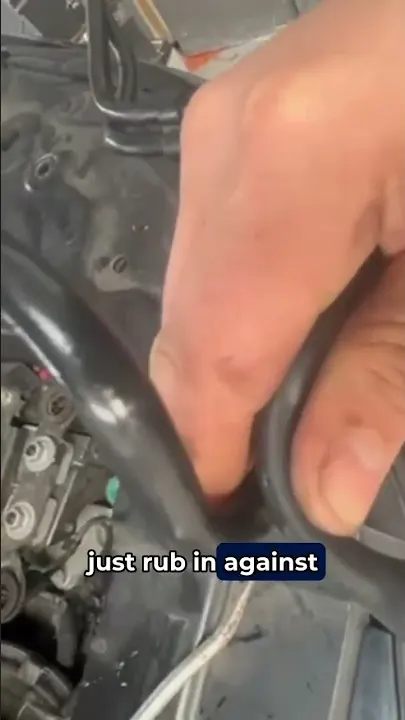
The first thing we do with any cooling system concern is a pressure test. We attach a pump to the coolant reservoir cap and pressurise the system to around 1.0 bar, which is the rated pressure for this engine. If the system holds pressure, the leak is elsewhere. If it drops, we follow the pressure loss to its source. On this Civic the pressure dropped steadily over about five minutes, and we traced the loss to a coolant hose running from the engine to the radiator. The hose itself felt soft in one section and had a hairline split at the point where it meets the metal connector, which is one of the most common places for a hose to fail because of the constant heating and cooling cycle it goes through.
Once the hose was dealt with we ran the engine up to temperature with the bonnet up and watched how the cooling fan and thermostat behaved. The thermostat, which is a valve that stays closed when the engine is cold to help it warm up quickly and then opens to let coolant flow through the radiator once the engine reaches its normal temperature, was opening late and not opening fully. We measured the coolant temperature with a laser thermometer at the point where it should be triggering the thermostat to open fully, and it was reading around 97 degrees Celsius before any real flow started. On this engine the thermostat should begin opening at roughly 80 degrees and be fully open by 90. A thermostat that is sticking causes the engine to run hotter than it should for longer periods.
Left Without Repair This Would Have Risked Serious Engine Damage Costing Many Times More Than the Parts We Replaced
A cooling system that is losing fluid and running warmer than it should is not something to leave and monitor. Coolant does two jobs, it carries heat away from the engine and it protects internal metal components from corrosion. When the level drops, the system moves less heat and air pockets can form around the cylinder head. Those air pockets cause localised overheating which can warp the cylinder head, a flat metal component that sits on top of the engine block and seals the combustion chambers. A warped cylinder head means a head gasket failure, and at that point you are looking at a repair bill that can run from 700 pounds to well over 1,500 pounds depending on how much damage has been done, compared to the cost of a hose and a thermostat dealt with early. Beyond the cost, an engine that overheats suddenly on a motorway or dual carriageway is a safety risk, because the driver can lose power at speed with very little warning.
We Replaced the Split Hose, Fitted a New Thermostat and Flushed the Cooling System Before Returning the Car
We replaced the failed hose with a new part, fitted a new thermostat and housing, and then flushed the entire cooling system through. Flushing means running clean water through until it runs clear, removing any old degraded coolant and any debris that can build up inside the system over time. We then refilled the system with the correct Honda specified coolant, which is a specific formulation and not a universal product, mixed to the right concentration for our climate. We pressure tested the system again once it was all back together, held it at 1.0 bar for fifteen minutes with no drop, then ran the engine up to temperature and confirmed the thermostat was opening at the right point. The temperature gauge settled exactly where it should and stayed there.
Signs to Watch for on Your Own Car, and How to Book in With Us in Walsall
Cooling system problems tend to give warning before they become serious, and if you catch them early the repair is almost always straightforward and affordable. The signs to look out for are a coolant warning light, a temperature gauge that sits higher than usual or climbs quickly, a sweet smell from the engine bay, visible wet marks or dried white residue around hoses and the radiator, or a reservoir that needs topping up more than once. If you notice any of those on your car, do not leave it to see how it goes.
At Platinum Vehicle Services we carry out cooling system inspections, pressure tests, hose replacements, thermostat replacements and full coolant flushes across a wide range of makes including Honda, Mercedes, BMW, Audi, Volkswagen and Ford. We are based in Walsall and cover drivers from across the area including Bloxwich, Aldridge, Willenhall and Brownhills. You can leave us a message any time, 24 hours a day, 7 days a week, on 07970901354 and someone from the team will get back to you as soon as possible. You can also find us and book in at platinumvehicleservices.co.uk.